> ## Documentation Index
> Fetch the complete documentation index at: https://docs.opper.ai/llms.txt
> Use this file to discover all available pages before exploring further.
# Pool node
> Rank several models per request on price, latency or throughput, and try them in that order.
A pool node holds several models and decides, on every request, which one to
try first. The first model that answers wins; if all of them fail, the route
takes the pool's fallback edge. A model node with fallbacks is a fixed order
you wrote down when you built the route. A pool re-ranks on numbers that
track what providers are doing right now.
 ## Add a pool
Click the **+** on an edge and choose **Add Pool**. A pool can go at the end
of a path, in an empty branch, or on another node's fallback edge — anywhere
an answer is expected.
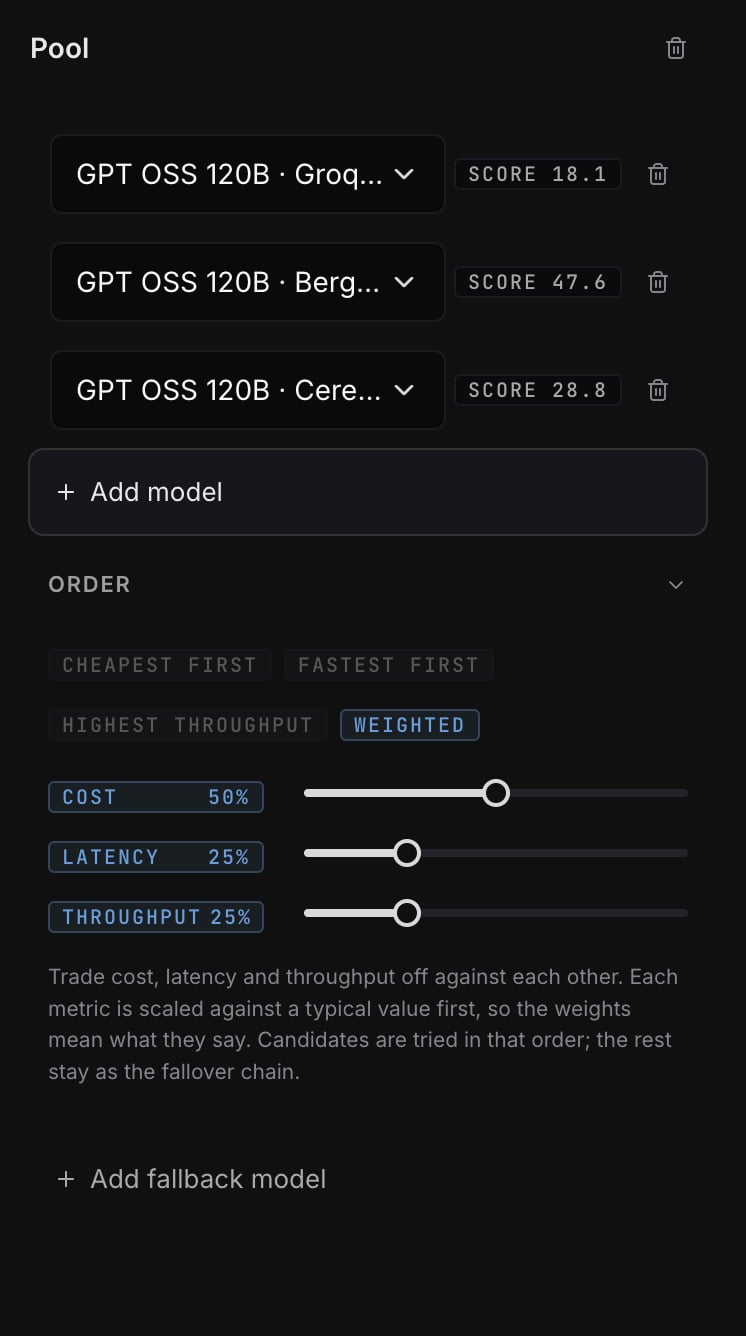
A new pool has two rows to fill, because two is the smallest set that can be
ordered; **Add model** takes it up to ten. Each row is a model picker that
offers individual provider endpoints only — `groq/gpt-oss-120b`, not the bare
`gpt-oss-120b` — since a bare name is already a pool of its own, and a pool
ranks single providers. A model another row already holds is not offered
again.
## Choose the order
| Order | Tries first |
| ---------------------- | ------------------------------------------------------------------ |
| **Cheapest first** | The lowest catalog list price. |
| **Fastest first** | The lowest median time to first token, measured over the last day. |
| **Highest throughput** | The most completion tokens per second, measured over the last day. |
| **Weighted** | A blend of the three, on the weights you set. |
The three bars under the chips are the weights, and each chip is a preset for
them: **Cheapest first** is cost at 100 and nothing else. Drag a second bar up
and the order becomes **Weighted** by itself.
Only the ratios matter. Each metric is scaled against a typical value first,
so "cost 50, latency 25" means price counts twice as much as latency. A
weight of zero drops that metric from the blend, so a model with no latency
number still ranks on a blend that only weighs cost.
Price is published, so every model ranks on it from the start. Latency and
throughput are measured from recent traffic across Opper, not just yours; a
model that has seen little of it has no number yet and sorts last until it
does. A pool that is new to you ranks fully on **Cheapest first** from day
one.
## The score beside each model
Each row shows the model's score for the chosen order right now: the sort
key evaluated for that model, lower tried first, from the same live numbers a
request uses. The rows stay in the order you added them — the score tells
you the order the runtime will use. A model the order cannot score reads
**no score** and sorts last. Hover the chip for the numbers behind it: list
price, time to first token, throughput and how many calls were measured.
## Failover
The ranking is a preference, not a filter. A model that sorts last is still
tried when everything ahead of it fails. When every model in the pool has
failed, the route takes the pool's **fallback** edge — a fallback model, or
End, in which case the caller gets the last error.
The trace of each call records the order the pool tried, and the response's
`meta.routing` names the model that answered.
## The same order as a routing rule
The [Routing rule](/control-plane/rules/routing) applies this ordering to the
pool behind a bare model name — every provider serving `gpt-oss-120b`, with no
graph involved. A pool node applies it to the models you list. Both use the
same vocabulary and the same ranking, so a rule and a pool that ask for the
same order rank identically on identical numbers.
## Add a pool
Click the **+** on an edge and choose **Add Pool**. A pool can go at the end
of a path, in an empty branch, or on another node's fallback edge — anywhere
an answer is expected.
A new pool has two rows to fill, because two is the smallest set that can be
ordered; **Add model** takes it up to ten. Each row is a model picker that
offers individual provider endpoints only — `groq/gpt-oss-120b`, not the bare
`gpt-oss-120b` — since a bare name is already a pool of its own, and a pool
ranks single providers. A model another row already holds is not offered
again.
## Choose the order
| Order | Tries first |
| ---------------------- | ------------------------------------------------------------------ |
| **Cheapest first** | The lowest catalog list price. |
| **Fastest first** | The lowest median time to first token, measured over the last day. |
| **Highest throughput** | The most completion tokens per second, measured over the last day. |
| **Weighted** | A blend of the three, on the weights you set. |
The three bars under the chips are the weights, and each chip is a preset for
them: **Cheapest first** is cost at 100 and nothing else. Drag a second bar up
and the order becomes **Weighted** by itself.
Only the ratios matter. Each metric is scaled against a typical value first,
so "cost 50, latency 25" means price counts twice as much as latency. A
weight of zero drops that metric from the blend, so a model with no latency
number still ranks on a blend that only weighs cost.
Price is published, so every model ranks on it from the start. Latency and
throughput are measured from recent traffic across Opper, not just yours; a
model that has seen little of it has no number yet and sorts last until it
does. A pool that is new to you ranks fully on **Cheapest first** from day
one.
## The score beside each model
Each row shows the model's score for the chosen order right now: the sort
key evaluated for that model, lower tried first, from the same live numbers a
request uses. The rows stay in the order you added them — the score tells
you the order the runtime will use. A model the order cannot score reads
**no score** and sorts last. Hover the chip for the numbers behind it: list
price, time to first token, throughput and how many calls were measured.
## Failover
The ranking is a preference, not a filter. A model that sorts last is still
tried when everything ahead of it fails. When every model in the pool has
failed, the route takes the pool's **fallback** edge — a fallback model, or
End, in which case the caller gets the last error.
The trace of each call records the order the pool tried, and the response's
`meta.routing` names the model that answered.
## The same order as a routing rule
The [Routing rule](/control-plane/rules/routing) applies this ordering to the
pool behind a bare model name — every provider serving `gpt-oss-120b`, with no
graph involved. A pool node applies it to the models you list. Both use the
same vocabulary and the same ranking, so a rule and a pool that ask for the
same order rank identically on identical numbers.